
AI and Computational Thinking Education for every student in India
Code-AI-India Foundation is committed to integrating AI literacy into India’s school curriculum, ensuring every child understands and leverages the power of artificial intelligence. Our goal is to prepare the next generation for a future where AI is a fundamental part of everyday life, fostering programmatic thinking and problem-solving skills across diverse communities.
Launching in 2026, we are developing innovative curricula, comprehensive teacher training, and engaging pedagogical tools to empower educators and students in government and low-income private schools.
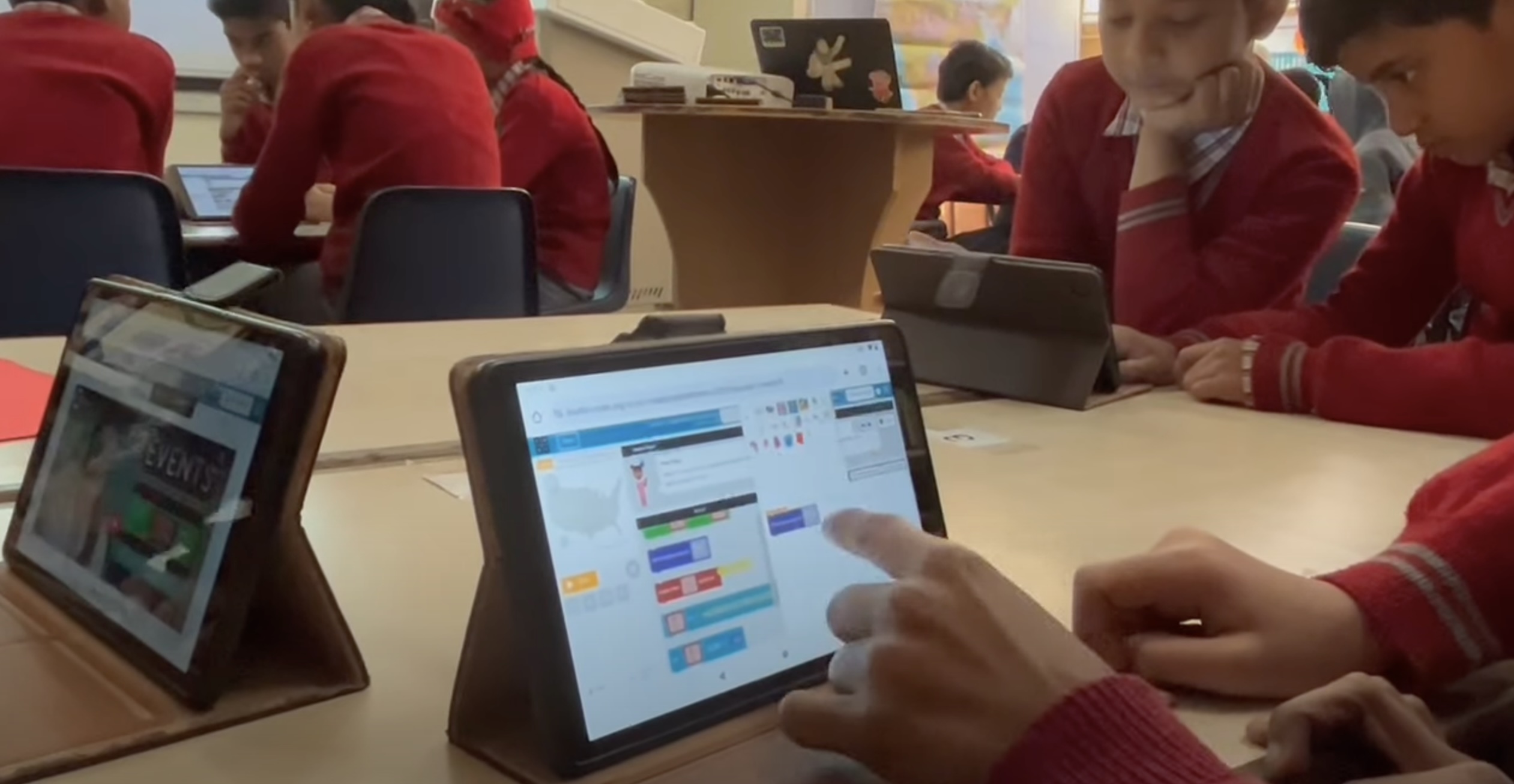
Catalyzing India’s CS & AI Education Revolution
The India Opportunity
India is home to the largest education system in the world, with over 270 million K–12 students and nearly 250 million youth aged 15–24—a population almost equal to that of the entire United States. This young demographic represents extraordinary potential, but today that potential remains largely untapped. Roughly 45% of Indian youth are unemployed or underemployed, not because they lack talent, but because they lack access to the skills that the modern workforce demands.
The urgency could not be greater. Artificial Intelligence is rapidly transforming every sector—from healthcare and agriculture to finance and education. Yet, India’s students are not equipped for this new reality. Computer Science (CS) and AI education remain luxuries, accessible primarily to urban, English-speaking children in private schools which are approx 31% of the overall mix, while the vast majority i.e 69% of India’s students enrolled in government schools —many of whom learn best in regional languages—are left behind.
The good news is that momentum for change is building. India’s National Education Policy (2020) and the National Curriculum Framework (2023) both emphasize computational thinking and AI literacy as essential twenty-first-century skills. The time is ripe to ensure that every child in India—not just the privileged few—has the opportunity to learn the language of the future, however domestic solutions to meet this opportunity do not exist yet, presenting an opportunity for world-leading established solutions to be localised and extended to help deliver the learning outcomes.
Our Vision for India
Our mission is to democratize access to computer science education worldwide. We believe that every child, in every classroom, deserves the opportunity to think computationally, learn coding and AI.
In India, our vision is bold yet achievable: to empower 10 million students and train 60,000 teachers by 2030, building the foundation for 50 million students by 2040 to participate in the digital economy.
We are not starting from scratch. We have already established a strong foundation in India. We are active in eight states through six major partners, having reached more than 1M curriculum users till date.. Our primary school curriculum is available in four regional languages—Hindi, Kannada, Marathi, and Tamil—and we have already seen a significant increase in female CS enrollment in regions where we operate. Our programs are designed to widely align with the wider national education policies, proving that scalable, inclusive, and equitable computer science education is possible in India.
This track record demonstrates that our model works. We know how to train teachers at scale, localize content for cultural and linguistic diversity, and inspire underrepresented communities, especially girls, to develop and build computational thinking capabilities.. And remarkably, we have achieved this impact while operating remotely from the United States. Imagine what becomes possible with a dedicated India team on the ground.
The Challenges We Must Overcome
Despite the promise, four major challenges stand in the way of large-scale transformation.
- There is a credibility and context gap. Implementing CS and AI education across India’s 28 states requires a deep understanding of local policy and education ecosystems—something that only a local presence can achieve.
- There is a teacher training crisis. Most government school teachers have never been exposed to computer science. They need structured pathways to develop these skills and earn recognition that advances their careers.
- Localization is complex. India’s 22 official languages and wide-ranging curricula mean that simple translation is insufficient. True inclusion requires cultural adaptation, contextual examples, and curriculum design aligned with local classroom realities.
- Infrastructure barriers remain significant. Many government schools lack internet connectivity or access to devices. Our solution—unplugged and offline learning models—ensures that students can learn computational thinking even without technology access.
These challenges are precisely why we believe we need to establish a local presence in India through a locally established entity, governed independently by a local board , aligned with the local government’s priorities—to drive systemic change, shape national standards, and scale impact sustainably.
Our “Go Big” Strategy for India (2025–2030)
Our plan has 5 central pillars:
- Inspiration: We will spark a movement and create a community of allies across Indian institutions in public and private sectors as we launch a Hour of AI campaign that mobilizes 10s of millions of students, teachers, parents, administrators, and influencers from sport, cinema, music, and fashion sectors.
- Localization: We will develop Indian-context curricula in at least five major languages—Hindi, Kannada, Marathi, Tamil, and Telugu—ensuring that lessons are culturally relevant and pedagogically aligned with state standards. Lessons will be modular, designed for shared-device classrooms, and adapted for different grade levels to meet India’s unique learning progression.
- Teacher Enablement: We will build an India-optimized professional development framework inspired by successful models from Mexico, Japan, and Chile. A network of teacher champions and facilitators will deliver training through a “train-the-trainer” model, enabling exponential growth in teacher capacity.
- Universal Access : To overcome infrastructure barriers, we will continue to design curriculum that can be used without the internet or advanced devices. Unplugged activities and downloadable offline modules will ensure that every student—regardless of connectivity—can participate.
- Advocacy : Our ultimate aim is to mainstream our curricula with the state curriculum . Towards this mission, we will begin with pilot programs in key identified states to establish evidence and expand systematically through partnerships with state governments, NGOs, and corporate allies. This model is proven, replicable, and ready for scale.
Investment and Impact
To bring this vision to life, we are seeking to raise $10 million over five years to establish a local India entity and a full-time team of educators, content developers, and program leaders.
We are inviting a founding group of visionary funding partners in the US to help catalyze this transformation. Each founding partner will make a three-year commitment of $XX million per year. This $XX million catalytic investment will not only fund operations but also signal to the Indian government, philanthropists, and global technology leaders that this mission deserves national priority. Parallel fundraising outreach in India will match these funds, creating a 1:1 partnership between global and local philanthropy.
By 2030, this investment will empower 10 million students with foundational CS and AI skills, train over 60,000 teachers, and set India on course to reach 50 million learners by 2040. The long-term payoff is immense: a generation of digitally literate youth ready to lead in the global AI economy.
Why Your Partnership Matters
Your support brings three crucial assets—catalytic capital, network access, and leadership voice. Together, these can transform this initiative from a program into a national movement. When technology leaders like you lend their credibility and vision, India listens. Your partnership can help shape policy, convene the right allies, and inspire a generation to see computer science not as a privilege, but as a pathway to empowerment.
The Big Benefit for India
By empowering 10 million Indian students with digital skills by 2030, we will not only build the country’s CS/AI talent pipeline but also unlock the potential of rural schools, tier-2 cities, and underrepresented communities. This movement will advance gender equity, drive economic opportunity, and position India as a global model for equitable CS and AI education.
We invite you to be a Founding Partner in this journey—co-leading the movement to democratize computer science and AI education for every child in India.
Together, we can turn potential into opportunity, and opportunity into a lasting legacy for millions of Indian children.
 Compute and Learn Foundation, India